

My son Theo and I have watched the Shawshank Redemption countless times. The movie’s an elaborate set-piece for a singularly profound lesson. Sitting on the couch with him, age 8, we watched Andy Dufresne stand up from his boat on a Mexican beach to greet his old prison friend, Red. Then we discussed it, what it means, Time and Pressure, the geologist’s hammer, the tunnel, the black rock beneath a massive oak, the money. Zihuatenejo.
We agreed that if you’re able to crawl through a tunnel of shit to get to freedom, you have an obligation to repay the friends who got you there.
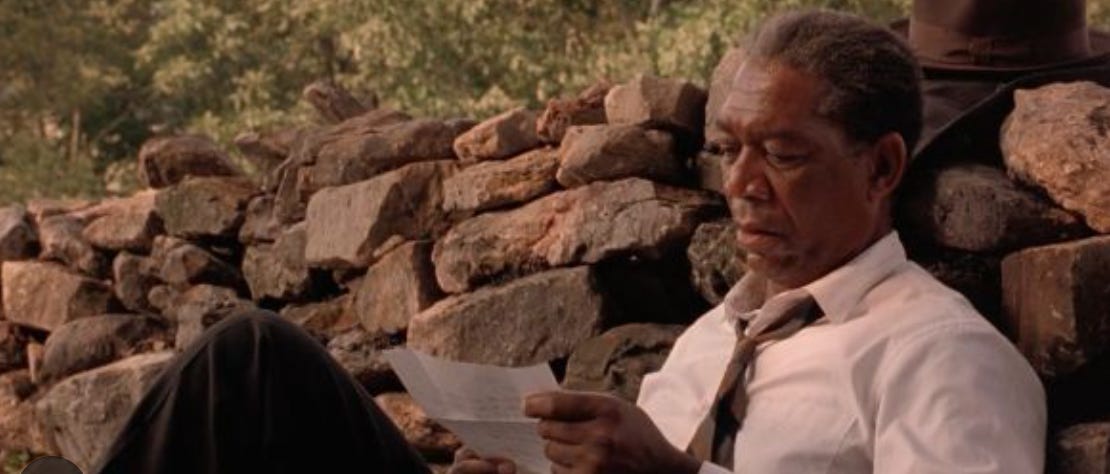
I idolize Stephen King. He’s been in AA forever and I think this is the strongest idea in all his work. Two ideas, hard to reconcile, obviously both true. ‘Salvation lies in helping others” and “There are no “Others””. They’re a matched pair.
Some of you know that until 2 years ago, I was very ill for a decade. Methodically, inch by inch, I’ve pulled myself back to well-being and vitality. I want to share some thoughts about how we might all “Help others” without becoming preachy.
Self help comes first. Obviously when the plane cabin depressurizes, you must put on your own oxygen mask. Call it enlightened selfishness.
2 years ago I desperately wanted to love and provide for my children again but I hadn’t taken care of myself yet. I started by agreeing to pills I didn’t love, walking many miles every day, going to meetings, changing my diet, reaching slowly back out to the world. The slowness of recovery sometimes maddened me but I built a routine as focused as Andy Dufresne’s - each step a chisel against the stone wall.
The aggregated milestones of wellness sound great - I lost 100 pounds, earned money, repaired relationships but these are really just statistics, the weight of pebbles gathered on a thousands walks. There’s a sober joke when somebody celebrates a big milestone - you ask “How’d you do it?” and they always answer, “One day at a time”.
My son told me this when came back from the hospital. He said “I don’t know if you can do it but if you do it will be because of consistency”. He was right. At the time I was angry, at everyone and everything that had led me to my bottom. His second tip was “Take the high road”.
I hope I have.
What I’m working on now is the beginning of this spirit, a little piece of software that knits together all the methods and practices I built to heal myself.
For example, every night at the exact same time, I kneel and pray to a precise sequence of text and images. Mine starts with a simple Hebrew prayer, recites the Prayer of St. Francis, includes a picture of my wife, to whom I say something kind, my kids, each when young, AA’s 3rd Step Prayer. Finally it closes on a picture of me as an 8 year old.
I look him in the eye and say “I did right by you today”.
The best feature is modest AI agent to which I complain. There is no analysis or validation in it - it listens as I rant and catalogs, building a compassionate model of me for later.
Ranting into a machine at midnight is how I stop arguing with the wall and get back to chipping away at it. That's the acceptance half. Recovery relies on acceptance, but acceptance doesn't mean staying still. Andy Dufresne could have prayed out the rest of his sentence, or he could have smuggled a rock hammer inside a Bible.
I like the latter.
Action and consistency have been my way out of hell. This app is the instructions I’d leave under a tree for a Fellow Travelers, the Red who had my back.
It is so tempting to divide the world into the well and sick, sane and crazy, rich and poor. My experience is those distinctions are less definite than they seem. Some days we’re Andy, trapped in a cell; some days we’re Red, walking curiously down a Maine road, wondering what’s under the oak in the distance.
I’ll push my app soon and hopefully others will find relief from, consistently enough so they can help others - both of those elements define what my son said 2 years ago - consistently walking the high road to freedom.