
Is Life a Game?
It all depends how you look at it

This philosophical question comes up a lot and always baffles me. To make it easier, I’m going to try to pick it apart, answer it and hopefully free us all from such inanity going forward.
The only place to start is with a definition of the word “Game”. There’s actually a field called Ludology and this is all they study.
“A game is generally defined as an activity with a specific goal, rules that create a structure, and challenges that require interaction. Key indicators include active participation, voluntary engagement, a defined set of rules, and a variable, often quantifiable, outcome (winning or losing)”
Let’s run those back. Does life have a specific goal? Not really, unless we say “staying alive”. Rules that create structure? Society, government and the endless push for money and prestige. Challenges requiring interaction? Ironically, this usually means “work”, the world’s shittiest game. A defined set of rules? Again, other than survival, life has few absolute rules at all. Lastly, does life have a quantifiable outcome? This is easiest of all in which wealth, respect and fitness can stand in as winning conditions, however unsatisfying. And Death.
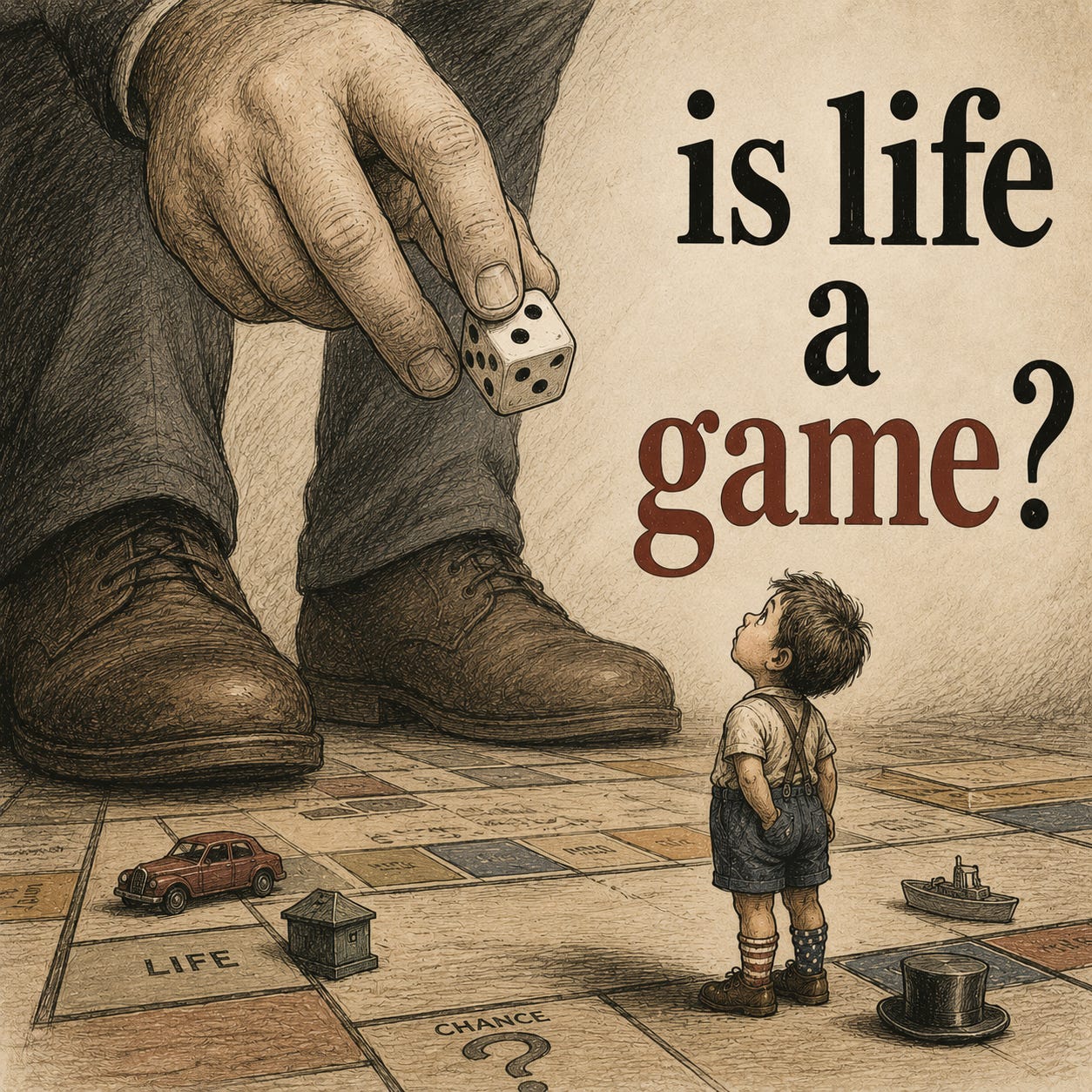
A much cleaner way of deciding whether life is a game is to say “A game is anything which is fun”. I once had a business partner whose family was very wealthy. One day, we were having staff problems - the result of people unhappy about a multi-week sprint, long hours with no extra pay. Totally reasonable.
My partner was unmoved, saying “If work was meant to be fun, the rich would keep it to themselves”. It was one of the most disgusting things I’d ever heard and I couldn’t figure out whether it was something he’d heard at home or whether he believed it.
We all need to work but the question isn’t whether we enjoy it - it’s whether life is a game.
Silicon Valley has a particular affinity for this framing, unsurprising since the industry is run by former child game nerds who have ruthlessly imported the mechanics of addictive gambling to power their attention factories. But as to the main question, the philosophic amongst them prefer something called Simulation Theory.
Briefly, this theory holds that we live one level down from a more intelligent species. Those favoring it like Elon Musk point out that in 50 years, humanity has evolved game technology from Pong - a dot and two bars, into games indistinguishable from reality. The argument works like this - in not too long we’ll have games with perfect graphics featuring AI character so intelligent they’ll be conscious. Therefore, he suggests, if our characters are sentient but naive, who’s to say we aren’t characters ourselves. When asked the odds that we’re not characters in someone else’s game, Musk replied “One in billions”.
You have to admire the chutzpah.
So to sum things up. Life is a game if you think it is. Remember, only primitive games have actual win states. Dice. Poker. Tennis.
Don’t play games given to you by others. If you want money, get it but don’t expect fireworks. Fitness is good but buff assholes are still assholes. Instead, I suggest you sit down quietly and list the things that make you feel wonderful. Giving a thoughtful compliment. Creating an opportunity. Things that change the game, that are off-the-menu items. Creativity.
And as you go forward, pay attention to how the game you’re playing feels. Happiness is so elusive so measure the little wins, delight and laughter. String these together in a way that feels fun and you’ll be playing on a much different game board.
Wasn’t it you who was telling me about finite v infinite games? I think about it all the time.
Life is a game. Write the rules.