
Mania Unmasked
Why we all seek transcendence

I am one of the 2.8% of Americans with Bipolar Disorder. The diagnostic bar is low - it means you’ve had one depression and one manic episode in your life. My condition puts me at the extreme end of the spectrum having had 10 of each, the manias lasting between a week and three months, the depressions for years. I explained depression last week and today I’ll turn to it’s florid twin, mania.
Each manic episode contains common themes and patterns and no two are the same. My first one, like most others, arrived in Springtime. I was 21, had been sober for 9 months and was living in a halfway house in Massachussetts. By comparison to later episodes, it was anodyne. My speech quickened, energy rose and I experienced a collapsing of space and time.
Colors captivated me and I would array drink bottles in precise shades and sequences. The interconnectedness of everything from flowers to cirrus clouds amazed me and everything felt predetermined, as if God was watching and operating through me. My sense of smell increased - epiphanies seemed so obvious, yet others found me confusing and unsettling. When I finally ended up in a locked ward, I asked the doctor who diagnosed me. “How can you tell?” and “Is there a blood test?”. He glumly shook his head. It was genetic, he said. I broke down and wept at the unfairness of it all.
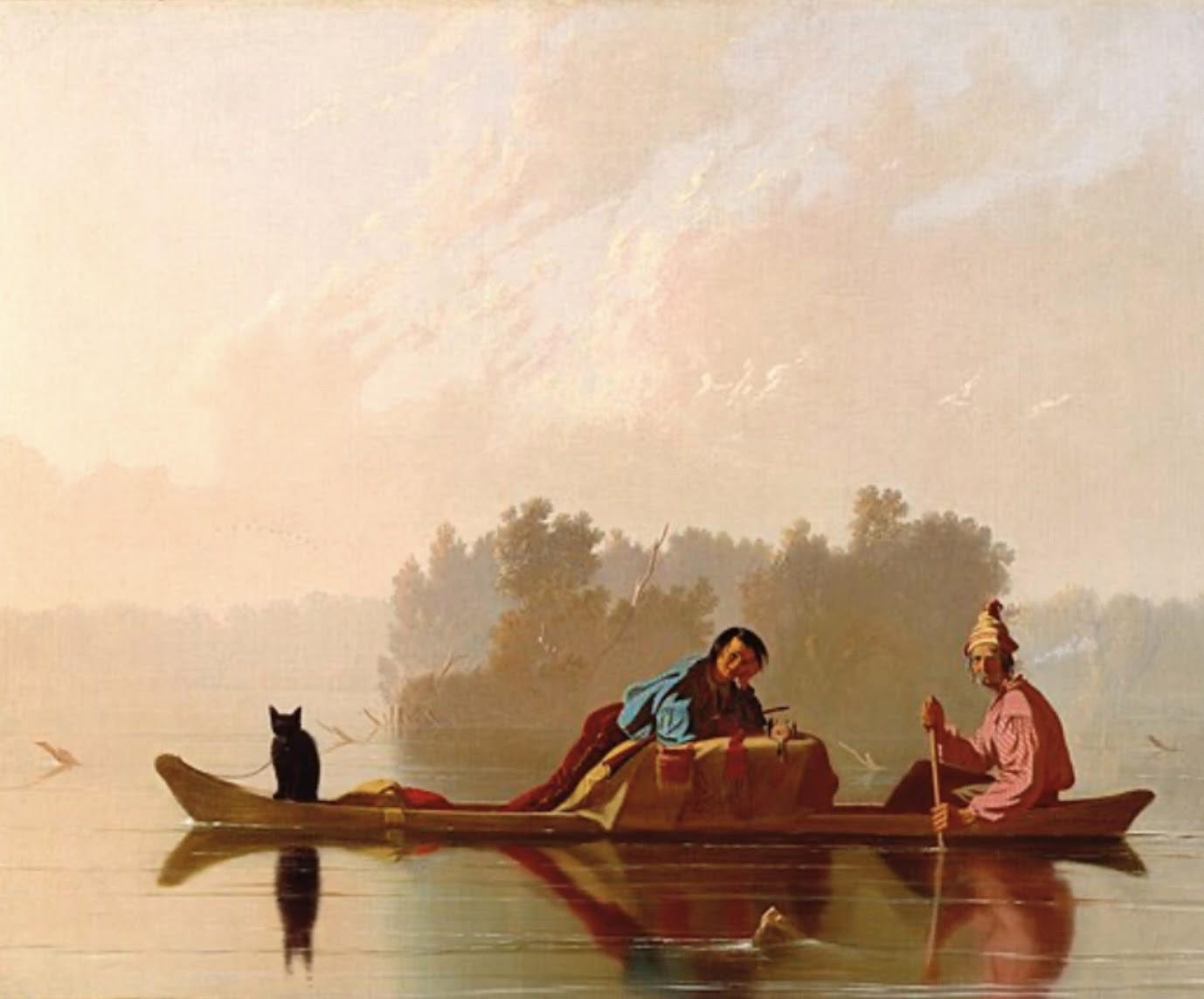
This George Caleb Bingham painting hung outside my hospital room for the next month- “Fur Traders descending the Missouri”. (1845) I was 22 and stared endlessly at it, superimposing cryptic meanings. Now I go see it in the Met. It comforted me deeply because it looked the way I saw the world. Everything connected, the water, sky and smoke, all swirling past each other in a scene that collapsed time and distance.
And the fur trader and his son on opposite ends of the boat, collecting pelts and animals. Made just before the Civil War, it implied a native American mother, a connectedness of people, waters, land and animals. Finally, on the far left of the painting sat the enigma. A small black animal, with a leash or shackle. All month I wondered what it was. A cat? A fox? Who knows but I realized then that museum walls were covered by people a lot like me.
That summer I learned how to break free of mania. Not easy but easier than cracking depression. Lithium helps and so does patience and lots and lots of walking. Mania has an almost physical element to it like a chain that must be sawed. While walking, often at night, I’d generate idea after idea. I remember one well - a movie about people who age in reverse. (Benjamin Button) There were hundreds and I couldn’t write them down because the meds made my hands tremor.
35 years later, my feeling about the disease have softened and changed. It is a curse but it is also manageable and therefore, also a blessing. I have seen and felt things others haven’t, most illusions but many beautiful and true. My explanation will show that what I experience is simply a highly-magnified facet of the human condition, the soul and the essence of creativity.
Why does manic depression exist? What function could it serve? The depressive side is easier to understand. Some people have always had more powerful emotions than others. Before modernity, some needed to rest and metabolize their feelings when overwhelmed. I see depression as the emotional equivalent of what a body does in hypothermia - shutting down external functions to protect the vital organs. Simplistic but basically accurate.
Mania on the other hand is perplexing, especially the form of it that breaks with reality into psychotic territory. How could psychosis ever be useful? Imagine prehistoric times. Having a trait that allows 2.8% of the tribe to follow a herd of bison, running without sleep for 5 days, spurred on by visions would be pretty useful. Most recently, societies needed leaders and often spiritual seers. They relied on altered states, the ability to see further forward and back and poetically incant about trees, the rain and the nature of God.
If you buy that, we’re not an accident or nuisance, just an extreme. Everybody needs peak experiences - love, transcendence, adventure. I’d love to explain what mania feels like but my words would be insufficient. The themes that endure are high creativity, associativity, an obsession with patterns in numbers, nature, language, music and art. If one feeling stands out, it is love.
My episodes always start with excitement at some discovery - 2 years ago I was walking home in May, feeling enhanced, when I realized it was precisely 40 years since my Bar Mitzvah. As I walked, the significance of 40 struck me - the number of years the Jews walked in the desert. By the time I reached my house I had a suspicion this wasn’t a coincidence and that I’d reached the spiritual promised land. I pulled out the old photo album and entered that time in my imagination, collapsing space and time. This began 3 months of mania.
My recurrent obsessions all fit together neatly. The first is that immortality is possible. This idea is complemented with a thought experiment that colors my thinking throughout an episode. “If immortality existed, who couldn’t you tell?” “The children”. My manic experiences are then riddled with wondering “What does this person know?” Everyone is either part of the conspiracy-to-live-forever or still in the dark. My actions often include creating ways to communicate this hidden secret to others.
I’ve struggled whether to share this final part. When manic, I often feel Messianic. When I’m normal, this admissions seems shameful - the epitome of narcissism and grandiosity. But it is unavoidable and true. It is the one thing I never share with my treatment team.
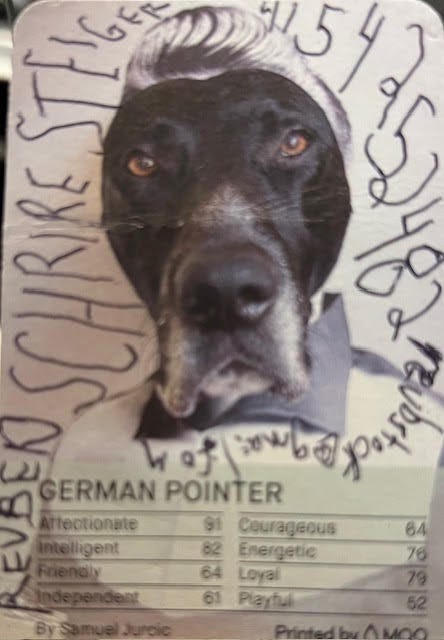
I feel it more in the sense of spiritual enlightenment and as a function of being interlinked with the cosmos. It is a secret I keep hoping I am just one of many. My artwork exists so others will know, which of course they never do. Living manic is very hard as creativity flows out of you, seeking understanding and connection with others. This, for example, was my home made business card. As you’d imagine, it didn’t lead to much business.
In some ways, Mania feels like exploring the world to decode and resolve the details of one’s own life. You have ecstatic exchanges with strangers who often are thrilled to have mysteries explained. These are many of the same impulses that non-sufferers satisfy by going to Burning Man or other peak experiences. For them, it lasts a week - for me, months. But these places we can go to reach the divine, whether the metaverse, concerts or camping, these are vital human experiences, meant to honor the mysteries of the world we inhabit, the selves we are.
Over the past 35 years, I’ve collected clues from my journey, sketchbooks, photographs and journals. All largely useless fragments until I became well but I will share some snippets as time goes one.
As I mentioned, mania obeys the laws of physics. In some way, I am able to visit heaven but I can’t stay. When mania ends, depression follows, the price we pay for the altitude of our state. It ends too. The future isn’t a sentence to keep repeating the cycle. . Research is getting close to unlocking answers. By understanding each side of the condition and following strict rules, manic depression can simply be an attribute of yourself, like left-handedness or diabetes. You might be shocked to hear this, but I wouldn’t trade my life with anyone.
I’ll end with the picture I least want to share. Taken right before my last episode ended, I’d walked to the office of a couples’ therapist, determined to save my marriage. Animated by love, I carried an alcohol rub to remove the writing on my arm. Mania makes you pour your heart out into the world.
I’ve saved it because it says everything and reminds me why I work so hard to live my truth, not wear it. We are all complex, illuminated spirits. Our greatest need is to be understood. Some fly too high to get there. What I pray for everyone is that the road is paved with honesty, consistency and compassion. And no words on my arms.
Good luck on your roads, Fellow Travelers.

Man, this is brutality honest and sincere. I'm touched I got to read it, thank you!