

One of my favorite books is Lawrence Weschler’s Mr. Wilson's Cabinet of Wonder: Pronged Ants, Horned Humans, Mice on Toast, And Other Marvels of Jurassic Technology.
Published in 1995, it describes David Hildebrand Wilson’s creation, a small museum that’s a cabinet of individually implausible exhibits, some real, some invented, deliberately unsortable. The museum (and book) flit between fact and fiction, shifting your consciousness by exhibiting objects that may or may not be real. By the time Wilson received the MacArthur genius prize, the museum was famous but attention-shy and open only a few hours each week.
I bring it up because I love the magic of it and because it’s often called a museum about museums. What is a museum, after all?
In the strictest sense, museums are places where a culture displays objects to tell stories about the past; they curate and enlighten importance with a mix of theater, magic, design and historiography. Museum have a bias for truth - Pirates of the Caribbean is an amusement park ride; the Met is a museum. This tension is why the Museum of Jurassic Technology is so subversive, - blending the techniques of natural history museums with stories of non-existent fauna in a way that tricks the senses and creates magic.
Art museums are strange creature. The paintings or sculptures are themselves real objects, but the destination is the same as Jurassic Technology, with art often warping the distinction between fact and fiction in the name of beauty.
I remember my first museum clearly, the South African Museum in Cape Town. At 4 years old, I was led by my mother past full-size scene of a T-Rex tearing a chunk of flesh meat out of a smaller herbivore. The scale and immediacy of the violence awed me.
We walked on and stopped in dim light in front of a well-lit window. Before us lay a diorama of a San bushman standing in the dry veldt ,wearing a loincloth and carrying a bow and arrow. A herd of springbok were painted on one the but appeared to lie in the distance.
In 2001 the bushman model was removed from the museum for it’s cultural appropriation and the use of the San’s likenesses without consent. Still, to a child, it was magical.
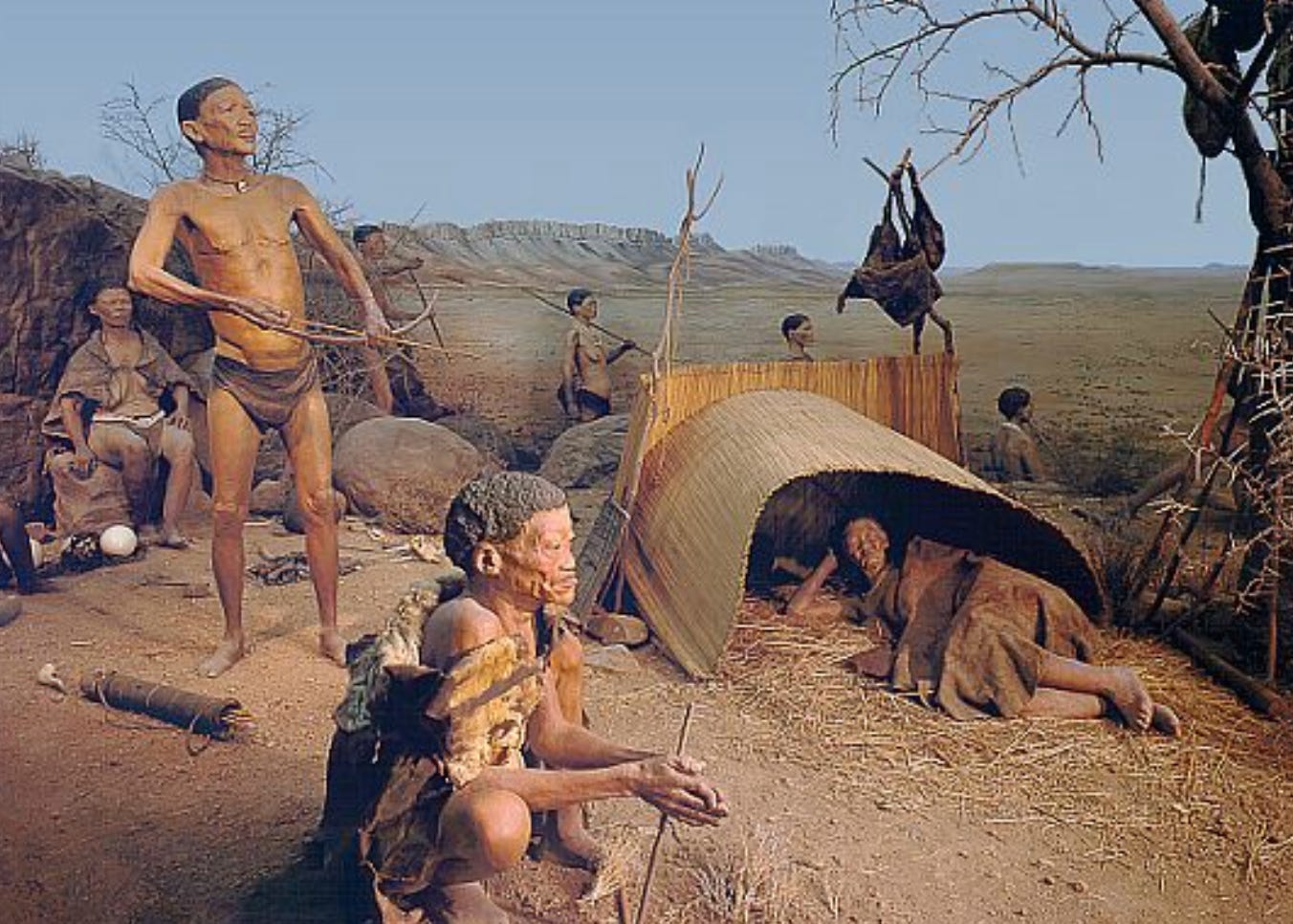
So-called 'Bushman' diorama, Iziko South African Museum, Cape Town (Elizabeth Rankin photograph).
Thinking of the world as a museum actually helps me a lot. My mind functions something like a constantly changing museum. New ideas, stimuli or facts all compete and force me to form theories as I battle to know what is true. Doing so requires explanations and I mix fact, observation and hypothesis to tell stories that might be true, alongside the facts I already know are.
I try to keep my memory palace tidy but fiction often slips by my guard. When I find these untruths, my theories are disproven and I feel pangs of shame and worry that I’ve stereotyped, conflated or guessed. This process runs constantly and I don’t rest much. When I’m wrong, I reassemble the structure of reality and start again, often with more nonsense. This is, I think, the way we all make sense of things and it requires imagination, error tolerance and humility.
Here’s a short guided tour of theories I’ve invented, retold as fact and retracted. None are totally accurate yet all contain a kernel of truth and that’s what makes them tricky.
“Salmon return to their birthplace to die”. I began saying this to establish a link between animals and their land - it’s an evocative claim, like cicadas sleeping for 13 years only to emerge, mate and die. And it’s true but only for Pacific salmon. With smell and geomagnetic senses, this proves that some animals can be tightly-linked to geography. Then it gets funky.
As someone who takes lithium carbonate, I became curious about why some people have bipolar disorder and others don’t. Somewhere in learning about the discovery of this miracle salt, I got my facts mixed up and claimed it was discovered when studying the rate of illness around the world. What I wanted to believe was that “special” people used to live in Jerusalem or Moab Utah, coevolved in harmony with lithium and suffered after migration. It’s not tue.
The truth is much more benign - an Australian psychiatrist named John Cade found lithium’s medical use in 1948 when he injected manic patients’ urine and the salt into guinea pigs. The urine did nothing but the lithium made the guinea pigs mellow.
The rest is confabulation and nonsense. Lithium is a common mineral and it hasn’t evolved with humans. Luckily it’s useful for batteries and medicine.
In 2013 I learned about the microbiome, the collective flora of our digestive tract which can be measured and studied and composes a large proportion of our genetic information. Like most people I think, I was fascinated because it might imply a tightly-meshed relationship between the land, food and air of where we lived. I wanted to believe that I prefer certain places because they resemble the web of nature in which I’ve evolved.
At that time, I remembered several years before, noticing a strange package near the eggs in my local Brooklyn supermarket. I asked the cashier and she told me “It’s edible clay”. When I returned home, I found an explanation for its appeal - the practice of geophagia or eating of earth, practiced in West Africa and South America as mineral supplementation for binding toxins and pathogens,
This supported the same wishful thinking as the biome, lithium and salmon. I wondered how those who buy it come to realize it’s what they want, particularly if several generations removed from the practice. This was also untrue. Eating clay is cultural and widespread but not encoded genetically.
Each recollection was locally-true and globally wrong. Now that I know the pattern, you’d think I’d correct the errors. But I keep doing this reflexively, trying to piece some divine or scientific order on the variety of facts, myths and confabulations that swirl together in the museum of my mind.
If I had to explain it I’d speculate that we all want to believe in our connection to the earth, ashes to ashes, dust to dust. We hope we are special and have a meaningful and unique destiny. Pronged ants, cicadas and salmon give facts we can use for support, science explaining why we do what we do. Ultimately the truth is different and probably more wondrous. We adapt, physically and in our minds, and can shape ourselves to any circumstances to survive.
This evolutionary power actually may be what best defines us. A species built to wander, wired to explain, over and over in stories approaching the truth.
I’ll keep going in my own private museum, just trying to figure it all out.