

I’ve always thought of myself as creative, though not through the common apertures of visual art or music. My palette is verbal. I’ve always loved words and figured out as I got older all the strange things you can do with them.
But the interesting part of my piece today is a head-on challenge to the notion of creativity itself. If I get you onboard, perhaps we can frolic in the wreckage of your preconceived notions. Let’s start with a definition:
“Creativity is the ability to use imagination to produce original ideas, objects or problem solutions.”
See the problem? “
Original“.
What does it mean?
It means doing something for the first time. Ever. To show how silly this is, I’m going to make us a model, taken from the world of math.
When I was young, my father worked with a handful of well-regarded Hungarian mathematicians. One stood above them all - the legendary Paul Erdős. Erdős’ fame came from a prolific production of theorems, partly a result of genius and also of being itinerant, scholarly and collaborating with everyone.
The thing I love most about him isn’t a theorem. It’s the picture he carried around of what mathematics actually was. Erdős believed in something he simply called “The Book” - a volume authored by God containing the perfect, most elegant proof of every theorem.
When someone showed him a proof, he’d check whether it was right, and then whether it was elegant. If it was right but clumsy, he’d say, “It’s correct, but it’s not the proof from the Book.”
He was an agnostic, by the way. His most famous line was: “You don’t have to believe in God, but you should believe in The Book.”
I find this amusing and humbling beyond conception.
Erdős only meant proofs. I’m going to steal the idea and take it further, which is what you do with any good idea. What it suggests is that there is a superset of everything: proofs, jokes, oil paintings, songs, insects, galaxies and animations.
Each has ingredients - the elements, the numbers 0-9, the primary colors, the notes. For each domain, there is a Book. The Book of Songs. The Book of Paintings. The Book of Snakes.
In other words, the Book already exists. Everything you will ever make is in it.
Now imagine that all the subcomponents, at the moment of conception, were placed in a massive combinatorial blender. It ran unimaginably fast and rendered everything that would ever be possible. I imagine the blender exploding and firing the results out into a vast, galactic ocean.
Our imagination is like a net we carry as we walk the beach of time, picking up pre-existing actual and possible things. The mistake we make is, like children, we get confused and think the things are ours, rendered by our brilliance, suffering and creativity.
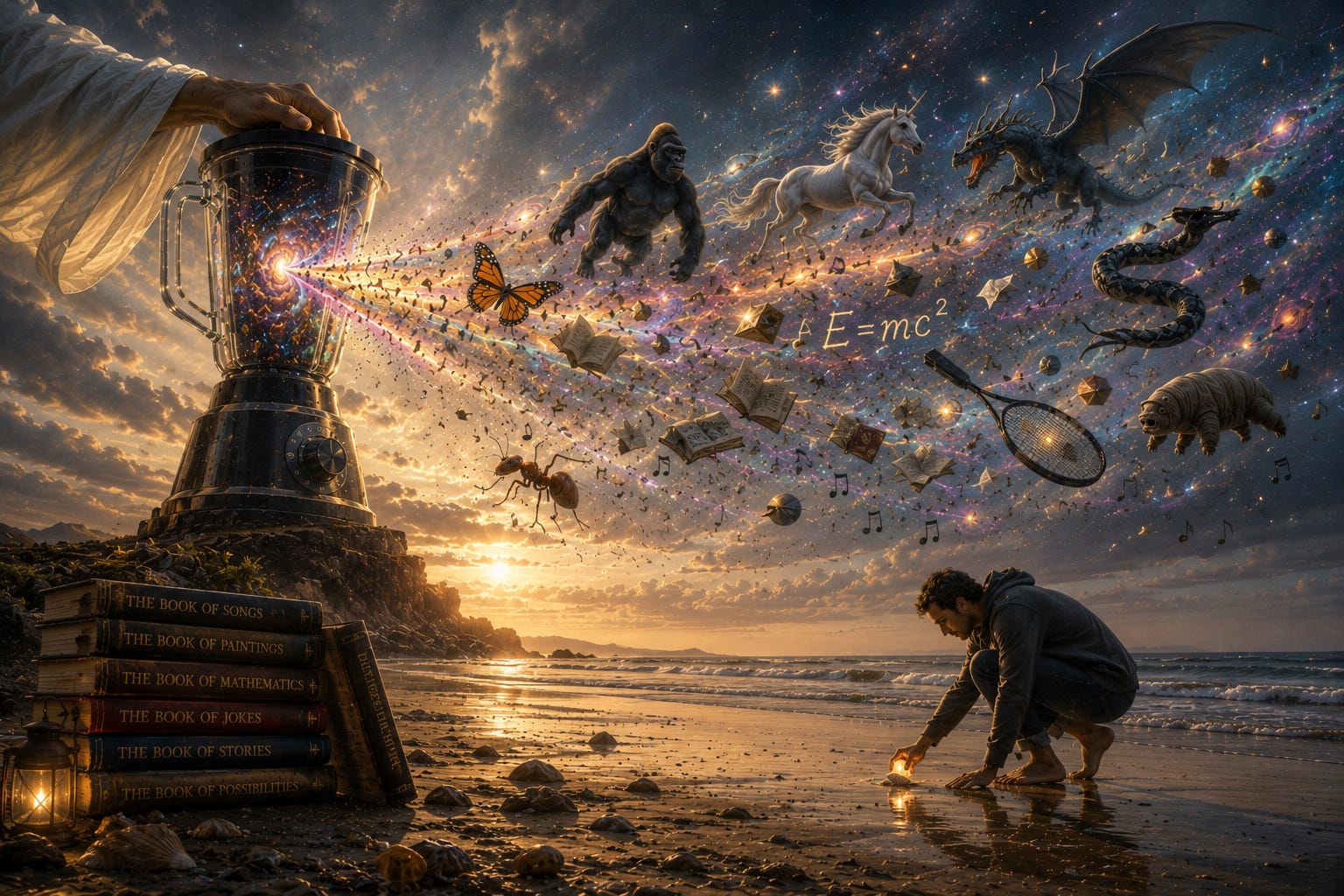
Are there things that will never wash up on the beach? A seahorse with a monkey’s head? A small, wet jellyfish thing called the “Secret of Pi”? “A Russian speaking anime rap artist”?
Perhaps, but I doubt it, given the size of God’s blender.
Now, the fair objection. If everything is already on the beach, the beach is infinite, and an infinite beach is useless. Surely what matters is which shell we bend down for. But look at what it does to the word we started with. “Original” was never about the shell. It was about the walk. Deciding to stoop where nobody has before.
So where does that leave us “Creatives”? We could easily lose interest now, since finding a shell on the beach is less glorious than designing it from scratch. But not for me. For me, creativity is like channeling and when it’s good, it never feels forced. In fact it works best when it feels like floating in the ocean, holding onto a desire for direction in a scenario where I control very little.
Which is why the word “Creator” makes me smile a little. It has become the job title for anyone with an audience, and I don’t say that to take anything away from them. It’s just a lot of word to carry. Your predecessor built the galactic blender.
If you’re creative, you’ve been handed a channel and a vessel. You attract ideas and notions made by the Creator, marvel at them a bit, and then share them with others.
You don’t have to take credit anymore with “I created this”.
Try out “I discovered this”.
Pause.
“It’s the only one and I’m giving it to you”.
Sounds better and best of all, it’s true.
All of which applies to this essay.
Plato said the poets don’t make anything, they’re possessed. The Romans said you have a genius, you aren’t one. Michelangelo said the statue was already in the marble and he just cut away the rest.
I went for a walk, and this is what was in my net.
Found, of course, not created.