
Taming Competition
Why we fight for finite things

I am the most competitive person I know and I’m not proud of it. Competition has led to feelings I don’t enjoy and behavior of which I’m ashamed. I’ve chased goals that don’t matter to get status I don’t value. Over the years, it’s morphed, matured and become something I understand and can live with.
We all like winning. But competition is nuanced - there are different types of games and different rewards. As a 5 year old, I burned with desire to beat my father in chess but also felt compassion, a desire not to hurt him, which of course, I never did. In kindergarten, competition fueled me - dopamine hits that said “You’re smart”. But life shows you the crack in a belief system when you’re ready. For me, it came on the soccer field in 4th grade.
I stood on the field, late in a game and out of nowhere, the thought hit me, “Would you rather score and lose or not score and win?” This was the first time I saw the flaw in my character - individual achievement mattered more than the overall game. I recognized the ugliness of the impulse but also its honesty.
Around the same time, I started focusing on track and field, choosing the 800m as my showcase event. A bigger prize, more dopamine, more glory. Unlike soccer, track brought feelings of intense nervousness, pre-race jitters. The better I become, the more I suffered. At 11, I vied for the NJ state title but with each race, the self-imposed fear before the starting gun increased. By the next year, I would lead a race for a period and then pretend to fall - a ploy to show I could have won if not for being tripped.
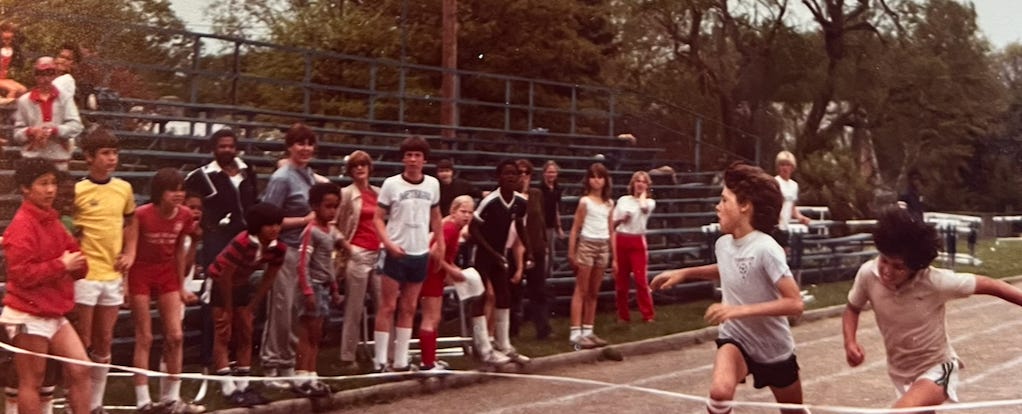
The tracks in those days were made of cinders and I’d commit to the act, diving and shredding my knees with tiny pebbles. I couldn’t have explained it to you at the time - it was simply a desperate physical lie to resolve my need to win with my vulnerability and the fact that I wasn’t the best. Today I feel compassion for that kid, trapped in a belief system that mattered only to him.
So what is competition and why does it trip us up? Competition is what you get whenever more than one organism wants the same finite thing: food, territory, mates, status. Darwin’s engine doesn’t require malice, just scarcity plus reproduction. In humans the twist is that we’re an intensely status-graded species, and status was historically a proxy for everything — access to mates, allies, protection, calories. So the drive isn’t really “to win”; winning is a heuristic the mind uses to chase rank, and rank was the real currency of survival.
Where we tend to get confused is by the two forms of status - dominance (status taken through intimidation, force, fear) and prestige (status freely granted because you’re skilled or generous and people want to learn from you). Joseph Henrich and Joey Cheng’s studied this split definition and reframes competitiveness as not one drive but two: the peacock and the professor are both competing, they’ve just found different games.
Money is the metric that twists most of us, inviting a game where we play with dominance at any cost to attain prestige. The confusion drives people who simply want security, freedom and respect to devote their lives to piling enough currency so their peers will compliment them as solid citizens. Naval Ravikant says of this trap “Play stupid games, get stupid prizes”. David Brooks frames it more precisely in The Second Mountain as “Living for your eulogy, not your resume”.
Nobody at your funeral will discuss your net worth or your promotions.
Years after my track antics, the same dysfunction showed up in academics. I’d always written easily, but at college I developed a phobia and couldn’t meet deadlines - I felt pressured and hunted and would invent excuses to receive extensions. Some imaginary judge I had concocted loomed over me and I couldn’t write lest it not be the best.
I wish I had resolved these fears of competition head on but instead I just abandoned the thing that made me panic in seeking the top of the podium. Miraculously, this led to a career where I discovered collaboration, a relay race rather than a solo endeavor. I loved it, decades after needing to score rather than win, I discovered a glitch in the success formula. The money was good and I thrived. But I was still competitive, uncomfortably so. I grandstanded, strived and envied others.
I learned that escape was difficult. I loved competition, striving for excellence and the compliments to brought me. I talked about positive-sum games and win-win scenarios but the thing I desired often required stepping over the body of a felled opponent.
Parenthood changed things. I know competitive people who brag about their children. Becoming a dad, for the first time I sat in a position where my winning was irrelevant - what guided my decisions was a framework in which “I” didn’t exist. Selfishness was meaningless. Success only mattered in terms of the kids.
Teaching drove this home even more deeply - it gave me a way to measure success in terms of my students. The very idea of competition was meaningless and the change in outlook and behavior was profound. Generosity with fear of rank was what I’d been seeking. The professor not the peacock.
So how do we all resolve this problem and stop striving for appearances and rank? The easiest answer is to want less but that is very difficult. A classic experiment shows that people would rather have the biggest house in a crummy neighborhood than the worst in a nice neighborhood. We are social creatures. The trap is that satisfaction only works if everyone else stops striving.
8.3B people now live on an earth that’s not getting bigger. Despite AI’s promises and dreams of Universal Basic Income, I’m pretty sure forces will continue to push us to compete. Scarcity will trump abundance, if only because we need status and will move the goal posts if needed.
The trick is to figure out what you’re competing for. Is it the biggest house? Fine. Usually, you’ll find you’re more like me.
I want to be loved. I want to be respected by colleagues and peers. I want to be with an attractive, dignified woman. I want to help others.
Money plays a role in some of these but mostly it’s just a side effect of doing the right thing, like a 4th grade soccer trophy that will get recycled eventually. So what is the proof that I’m living in line with my values and striving for what I want?
People can sense I’m not fighting over a limited quantity - my goal is increasing the size of the pie, not my share. Colleagues respect me. Friends call me in need.
Most of all, I hoard love not trophies and it feels much better.
Brave piece! Well done!