

I’ve had 10 arguments over the past six months about whether AI is OK to use for writing. To be clear, I’m usually the recipient but sometimes I’m the sender. Last weekend, after learning of Substack’s new AI detector, Pangram, I tested my latest piece with it and was ashamed when it found AI. Lots of it.
It took 2 days to rebuild the article from scratch.
Before we start commiserating about AI tells like “Tapestry” and “Delve”, lets explore why AI writing is problematic to begin with. If a colleague shared an image with me of my face superimposed on Iron Man’s body, I might not laugh but we’d both know it was AI-generated. Not offensive or deceptive, simply a tool. What about a slide deck? I’d instantly recognize the Claude design signature look but I’d only judge the written words to figure out if it was my collaborator’s voice or AI.
Writing is thinking and if I spot one artificial tell, I conclude my partner is trying to slip one by or asking me (without asking) to speak to the LLM. Both are uncool.
This effect isn’t confined to AI writing. If you’ve ever had a contact ask you to use their Calendly or other calendar tool, you know the feeling of being pawned off to software. I interpret the move as imperious, as if they are too important to schedule themselves. What’s weird is our emotions over logic, the tool is capable and time-saving yet we resent it as a show of bad manners. On the other hand, old fashioned voicemail doesn’t ruffle feathers since it’s not perceived as a brush-off or request to “speak to the robot”.
This is just the beginning. Several areas of AI writing are about to change. The first will be behavioral - people are having hard conversations with each other and will struggle to set boundaries or explain why it’s rude to share AI writing. Secondly, we’ll heighten our innate detection ability, getting better at recognizing and rejecting structural and linguistic tells that betray trust. Thirdly, an arms race has begun, pitting authors and students against Pangram, Grammarly and a fleet of detection tools.
The detection is the lure, not the revenue driver. Those tools will end up making most of their money de-AI-fying AI writing. If this seems strange it’s because it is. People pay to write with AI and pay again to hide it. AI style, words and cadence will bleed into our expression, in some cases becoming permanent. I’ve found myself saying “legible” more and about things not related to reading.
So how did this happen to us? When foundation models are made, they are fed an enormous amount of written information. None of the irritating words were overtly requested by the model makers. They evolved as accidental winners of a machine that makes sense by predicting the next word with a style that looks eloquent. “Delve” was an early first offender. Innocent alone, maddening when served by the ton.
The same is true of the notorious em-dash. AI wasn’t told to overuse it — it simply preferred it to the alternatives — choppier sentences or dated semi-colon. Now removing them is de rigeur for hybrid writers, like pulling ticks from a dog’s coat. “Not-this, that” is even more interesting. It seems to have evolved for both rhetorical utility and to fit a rhythmic pattern AI likes. We encounter it as a useless vestige of times past, a magician’s flourish, used long after the trick is obvious.
The most glaring AI tells seem to have almost been invented by the models. These include a fleet of linguistic conventions designed to physicalize the virtual. My current bugbears include “shifted”, a term that is inserted to signal a change of mind or feeling without trying to explain what happened. “Something shifted” we are told without attribution, as it our state of mind was a physical object obeying the laws of physics like an orange that just rolled off the table. No mention of pushing or titling. It just shifted.
The shift method seques frequently into what I call “Shape Speak”. This is a tool for lazily comparing ideas without proof that simply asserts comparable geometry. For example “At first glance, socialism and progressivism appear distinct, but they share the same underlying shape”. Really? Is it round? Square? Cylindrical?
Once we’re willing to accept shape-ish hand-waving, we’re greeted with ideas being described as sharing vague physical traits like “architecture”. Often the AI will claim ideas are “pieces of the same machine”. More handwaving and engineer-ish sincerity. Architecture and machine sound formal, like a blueprint is involved when it’s just laziness dressed up as scientific precision.
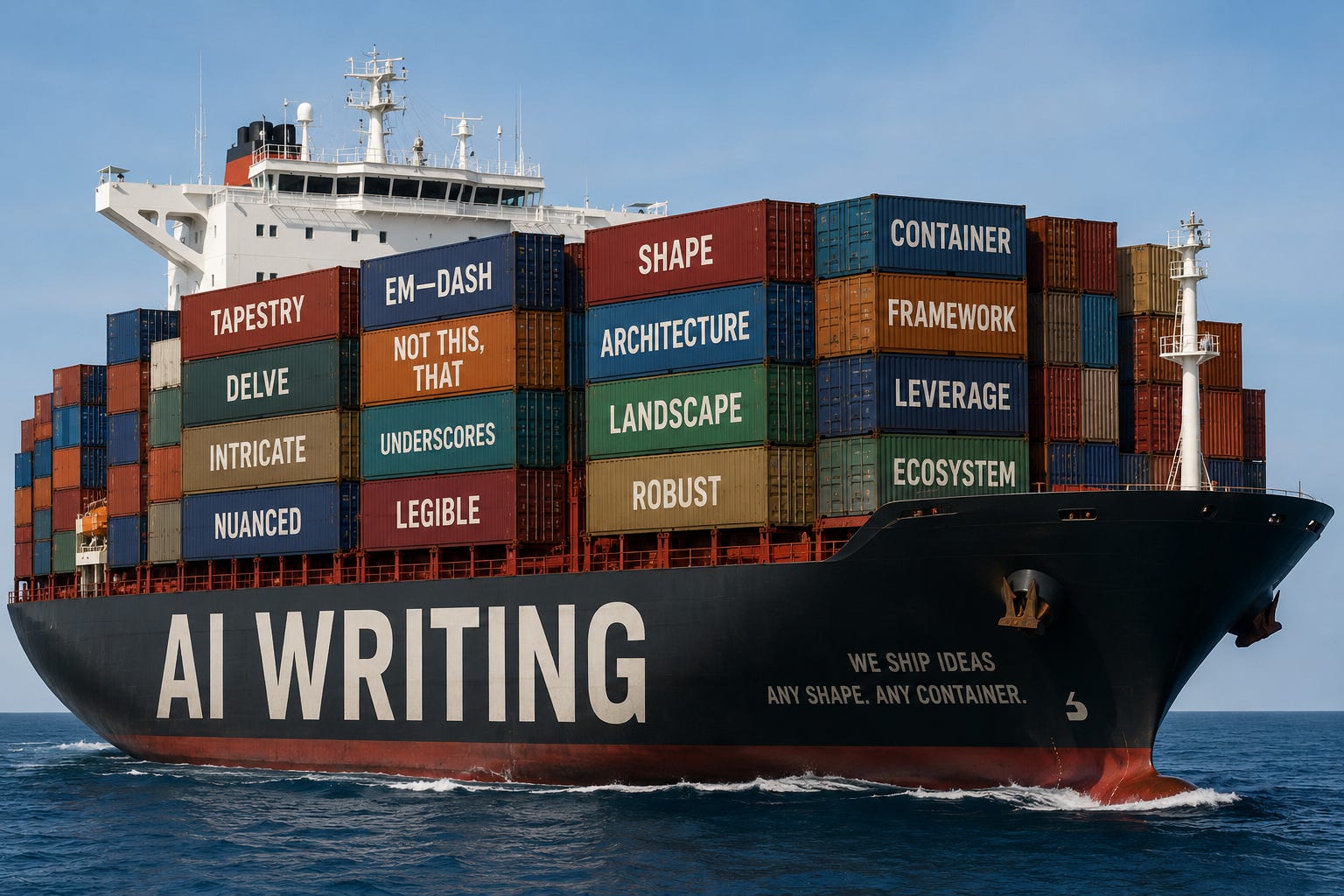
All this wordy nonsense climaxes with the word “Container”. Socialism and Progressivism are asserted to share the same shape which is absurd but fine. The AI then begins to blather about which ideas go in which Container. This is usually where my brain quits - ideas aren’t physical, they don’t have shapes, contour or mass and yet those words made them easier to label, package and digest without actually thinking.
I’d love to hear your favorite slop words and learn how you tame AI writing in your practice. In the meantime, I’ll close with some ideas on how to avoid and reject the AI writing supply chain.
Hold onto writing your own stuff, word by word
Use AI in your writing practice sparingly and with caution
Tell your LLM as the words and conventions to avoid using this guide
Make sure you’re not sharing things that aren’t yours. If you do, disclose.
Test yourself with Pangram etc. It may be sobering.
Keep writing.
You really can’t have it write for you unless the output is intended solely as descriptive reference, like documentation or a user manual, or where you simply don’t give a damn about the recipient, like in most customer service or LinkedIn.
But it can be as essential tool to argue against your arguments or point out bad flow. It is great to look for other thinkers who have approached the same idea, but you need to subsequently read those writers.
The simplest way to think about it, for me: use AI to do your work if you don’t care about learning or engaging with the material or if you don’t really care about the recipient/reader.