

I met my wife Hilary in 2000. By 2003 I wanted to ask her to marry me, and I had no idea how to buy a diamond.
My father, a math professor, had just awarded a PhD to a student whose father was a diamond merchant in Antwerp. I wrote to the man. Over a series of letters I told him about Hilary, how much I loved her, what we hoped for. He recommended a stone. I bought it sight unseen, on trust.
Weeks later, on an empty beach, I proposed and she said yes. We have two children, the reward for a promise marked in stone.
The man was Arthur Langerman. He was born in Antwerp in 1942. In 1944 his parents were deported to Auschwitz, where his father was murdered; his mother survived, and Arthur spent the war as a hidden child.
He came up in the diamond trade as an apprentice cutter. An eye for geometry and light, and a taste for rare colored stones at Langerman Diamonds made him famous and wealthy.
But Langerman’s legacy won’t be the stones. Alongside them, for more than sixty years, he collected something far less rare: visual anti-Semitica. Postcards, prints, paintings, figurines, the whole iconography of the hooked nose and the grasping hand. It’s the largest such collection in the world, and it now sits in an archive at the Technical University of Berlin, of all places.
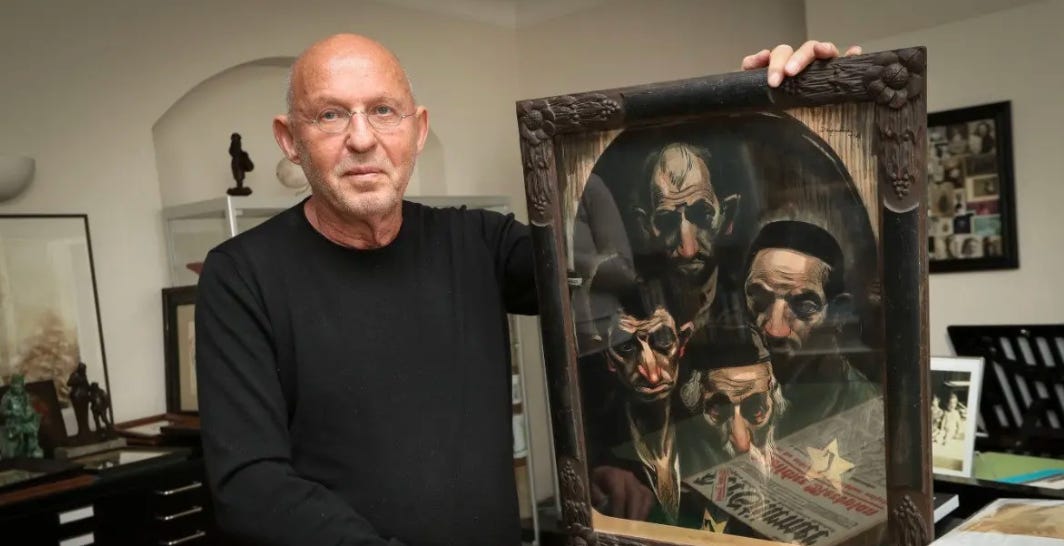
He assembled it for one reason. To show that the thing we all want to believe — that it can never happen again — is false.
I’ve thought about him a lot this week
My feeds have overflowed with anti-Semitism. I’ve kept quiet about this for three years, and I want to be clear about what I’m not saying. I don’t think one side is simply right and the other wrong in Gaza, and I’m not going to litigate it here. I want to describe what pushed me to write, because the sequence is the point.
Last week Macklemore opened for Ed Sheeran at MetLife Stadium and led 80,000 people in a chant of “Free Palestine” for several minutes. Pink, who is Jewish and was on the tour, pulled out. Millions of people insisted this was politics, not hate. Anti-Zionism, not anti-Semitism.
Then the picture below surfaced. Macklemore, years ago leading a crowd, dressed in Jewface. I’ve spent my life being told by people why this is no different from an actor playing Shylock.

But I let it go. Then I heard a YouTube commentator walk through how the story ended. Robert Kraft, who owns the Patriots and their stadium, told Sheeran he wouldn’t host the tour with Macklemore on it and would rally other venues to do the sameThe commentator described Kraft’s allies, in a parenthetical, as “the billionaire class.” Then he asked his audience to rise up against the people who control the media, the banks, the levers of power. I stopped the video before he got where I knew he was going.
The Epstein files.
Jewish kids learn about this early. The blood libel. The cabal. The Rothschilds at the top of a secret world government, drinking the blood of Christian babies. The strange thing is that when you first hear it, it’s obviously absurd. If we had all that, why couldn’t we get away from the Nazis, or the Russians, or the Poles, or the Romanians?
I used to think “Never Again” meant never again. I don’t anymore.
What I’ve come to understand instead is this: the easiest way to dehumanize a people is to accuse them of exceptionalism.
Not the good kind. Nobody is enraged by Nobel Prizes. What enrages people is the idea that Jews think they’re chosen. The actual concept is modest and demanding — that we’re obligated to live a certain way and to help repair the world. That’s not what people hear. They think they’re special.
And once a people is special, they can’t be ordinary victims. Their money is never just money, their influence is never just influence, their dead are never just dead. Every fact about them becomes evidence. Kraft objects to a chant; within a day it’s the billionaire class; within a week it’s the banks and the files.
You can see it in the faces of certain artists. Roger Waters almost grins as he defends wearing a Nazi-style uniform on stage and flying an inflatable pig painted with swastikas and Stars of David. He swears he’s not an anti-Semite. He just opposes Israel. To a Jew this sounds like a man in a Klan hood explaining that Black people shouldn’t take offense, he simply doesn’t care for Kenyans.
Not every Jew supports Israel. But the two are intertwined, and Zionism at its root is the belief that we have a right to return to our spiritual homeland. Argue with that all you like. But when the argument runs through the Protocols of the Elders of Zion, it’s anti-Semitism, and it doesn’t stop being anti-Semitism because you swapped a word.
So I think of Arthur Langerman. A gentle, precise, soulful man in his home in Antwerp, who spent his working life turning rough stone into something that reminds us how rare a life is, and his other life collecting proof of what people do when they forget.
Maybe he saw the Macklemore picture this week. I imagine him uneasily content that his life’s work is holding up. This will always happen again, if we let it.