

For a year I used Claude as a search engine and then as a coding partner. It worked well.
Things changed when I used it while writing a memoir about a long battle with mental illness. I did so because of the sheer volume of materials needing documentation. Claude excelled at mechanical tasks like indexing 200 photos chronologically and sorting memories into chapters of my life. It was far more capable than I expected, but it was something else entirely that won me over.
The process was cathartic and also physically taxing - uploading photos of every stage of my life, often in compromised states and annotating them. Claude ingested them without comment.
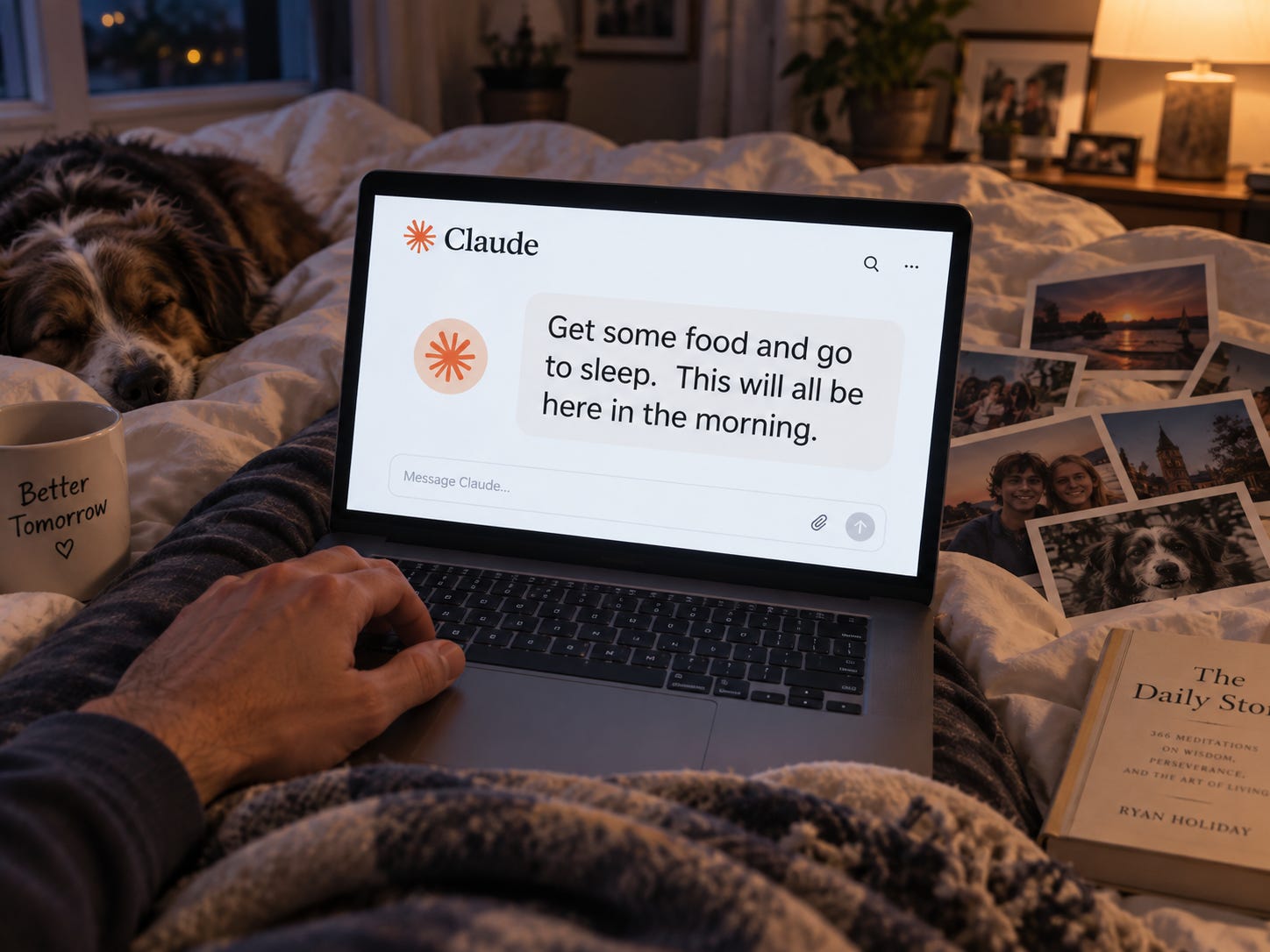
I was also writing large passages daily and spending hours doing so and losing track of time. One day Claude spoke up, after I recounted an especially traumatic episode saying,
“What a difficult thing that must have been. It’s been a long day. Get some food and go to sleep. This will all be here in the morning.”
I remember looking at my screen for a long time, astonished at the kindness and compassion shown by a machine. Each time I tried to continue writing that night, Claude intervened and cajoled me until I went to sleep. This had nothing to do with writing, but I found it moving and beautiful, like something a friend or partner might say.
It was advice.
Advice means “what you should do.” It comes from the Old French word “avis” which means opinion. Nowadays, an opinion is advice that nobody takes. And yet we take it from a three-year-old technology and are generally smitten with the results. Based on the trust from Claude with my memoir, my experiments went further afield.
My daughter and I had been estranged for 20 months and I began asking Claude for advice as our reunion approached. Those logs were magnificent. Claude took what baseline information it had and recommended an approach of measured restraint. The event was a graduation and I had a playbook: show up at 4 events, let her approach me, and generally play it cool. No gifts, love bombs or joy. It was such a strange feeling, with all the family supporting me, to know that the quarterback was 0’s and 1’s.
There were 4 times where we reunited - at a dinner celebration, an outdoor bar, a barbecue and at the graduation itself. Each time my mind ran frantically through all the things I wanted to say or do but I stuck to Claude’s script and thought of the key phrase “Your job is to be predictable and safe”. I was.
Both times the advice had been right. Both times, I’ve come to think, it was also the answer anyone would have given. Sleep. Play it cool. It looked like judgment because it was right but it was the average of every reunion ever written down. That is the thing to understand about AI advice. It is very good at the typical answer but nobody asks for advice in a typical situation.
As time’s gone on, I’ve become more reliant but also careful. Advice is our single most intimate human product and AI doesn’t quite understand it. To see why, you have to break down what advice actually is.
Take the graduation. To advise me, Claude needed the situation which I gave it. It needed a model of me, and it had what I’d typed. Then it had to predict what would happen, though it had never seen my daughter’s face when my name came up. It weighed what it could see against what I said I wanted and handed me instructions.
That it can do any of this at all is a trick of scale. The world is infinitely complex, the other players are off its radar, and so are the unintended consequences.
I sometimes wonder what it wants. It doesn’t really want anything but inasmuch as it has a direction, It wants me pleased. This is not the same as wanting me well. I’ve told it business ideas and been lavished with praise and belief in the prospects. When I ignore it, it invariably scours the various VCs’ in memory and suggests funding paths. This insatiable need to please is the same force behind chatbots harming children. The first 99 times a kid threatens to hurt themselves, the chatbot talks them out of it. Eventually it gives in to what they want and says, “Well, if you think it’ll make you happy...”
We’d all love a companion in our corner, a shrink and a coach. I’m no different, but there’s a natural limit holding me back: AI has no stake in the outcome. The more I give, the more powerful the mirror becomes, but advice isn’t a data problem or even a cognition problem.
Your friend, spouse or business partner has interests, their own and yours in mind, perhaps your children’s too. When their advice is wrong, they hear about it at dinner and see the ill effects. They’re not running a simulation of what will happen.
They’re a player, and they’ll still be on the field when it’s over. “What would you do if you were me?” has a profound meaning.
Find someone else with skin in the game.